Embedded Systems · Prototype platform / board designs in development
Sentinel Research PCB Platform
A shared embedded research-board platform supporting AeroHive, confined-space sensing, and battery-decomposition early-warning concepts.
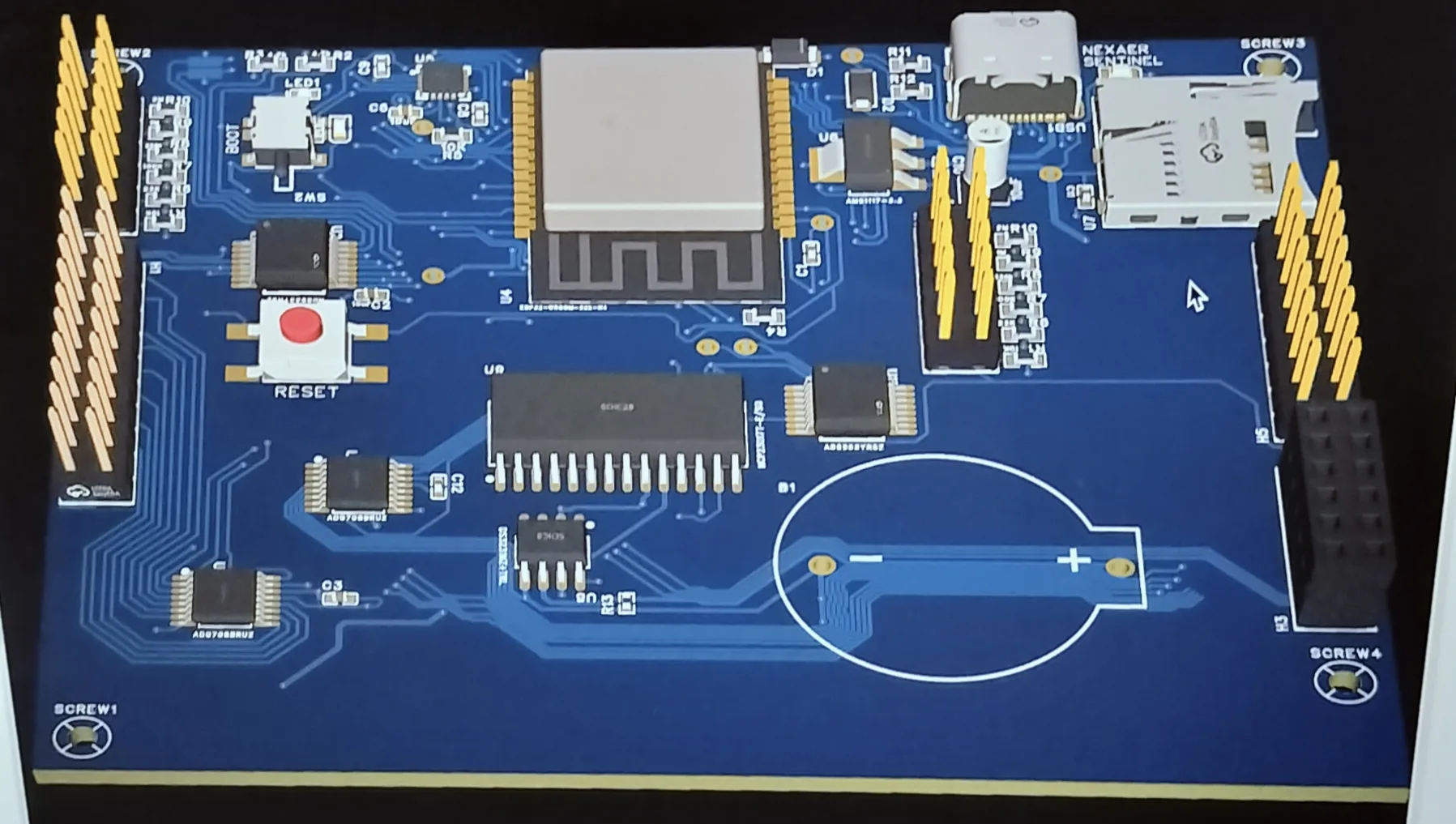
Problem
Three sensing programs needed a practical electronics foundation: regulated power, embedded processing, sensor interfaces, local storage, communications, and enough flexibility to support different experiments without starting from zero each time.
Description
What I built or investigated
I developed a shared Sentinel research-board approach spanning schematic capture, component selection, PCB layout, assembled-board review, fabrication, and first-board bring-up. The platform supports AeroHive biological sensing, B4 confined-space sensing, and battery-decomposition research while allowing each program to use its own sensors and front-end circuitry.
Iterations
The work did not happen in one jump.
- 01
Defined common functions that could be reused across the sensor programs instead of designing three unrelated controllers.
- 02
Captured the board design and routed the PCB in EasyEDA while balancing sensor interfaces, power distribution, headers, storage, and mechanical mounting.
- 03
Used assembled-board rendering to catch placement and access problems before ordering hardware.
- 04
Fabricated the first physical board for AeroHive Sentinel through JLCPCB.
- 05
A first-power-up failure caused by incorrect chip-pin orientation led to a stricter schematic, footprint, rail, and current-limited bring-up process for later designs.
Result
Where the project landed
One fabricated AeroHive prototype board, two additional research-board designs in development, and a repeatable review and bring-up process that now carries across the Sentinel program.
Lessons
What carried forward
- Shared platforms save effort only when common functions and project-specific sensor front ends are separated deliberately.
- 3D board review catches mechanical mistakes that schematic review cannot.
- Power-tree validation and package-pin verification deserve their own sign-off step.
- A failed first board can still produce durable engineering value when the process changes afterward.
These images represent the broader Sentinel research-board program. The physical board shown on the AeroHive page is the fabricated AeroHive Sentinel prototype.
Images & evidence
Work in context
Documentation status
This is a living case study. New photos, measurements, diagrams, source files, and exact outcomes can be added without changing the permanent project URL.
Continue exploring
Every catalog entry has a permanent page.
Use the archive to move between embedded systems, software, research, fabrication, networking, manufacturing tools, and field repairs.